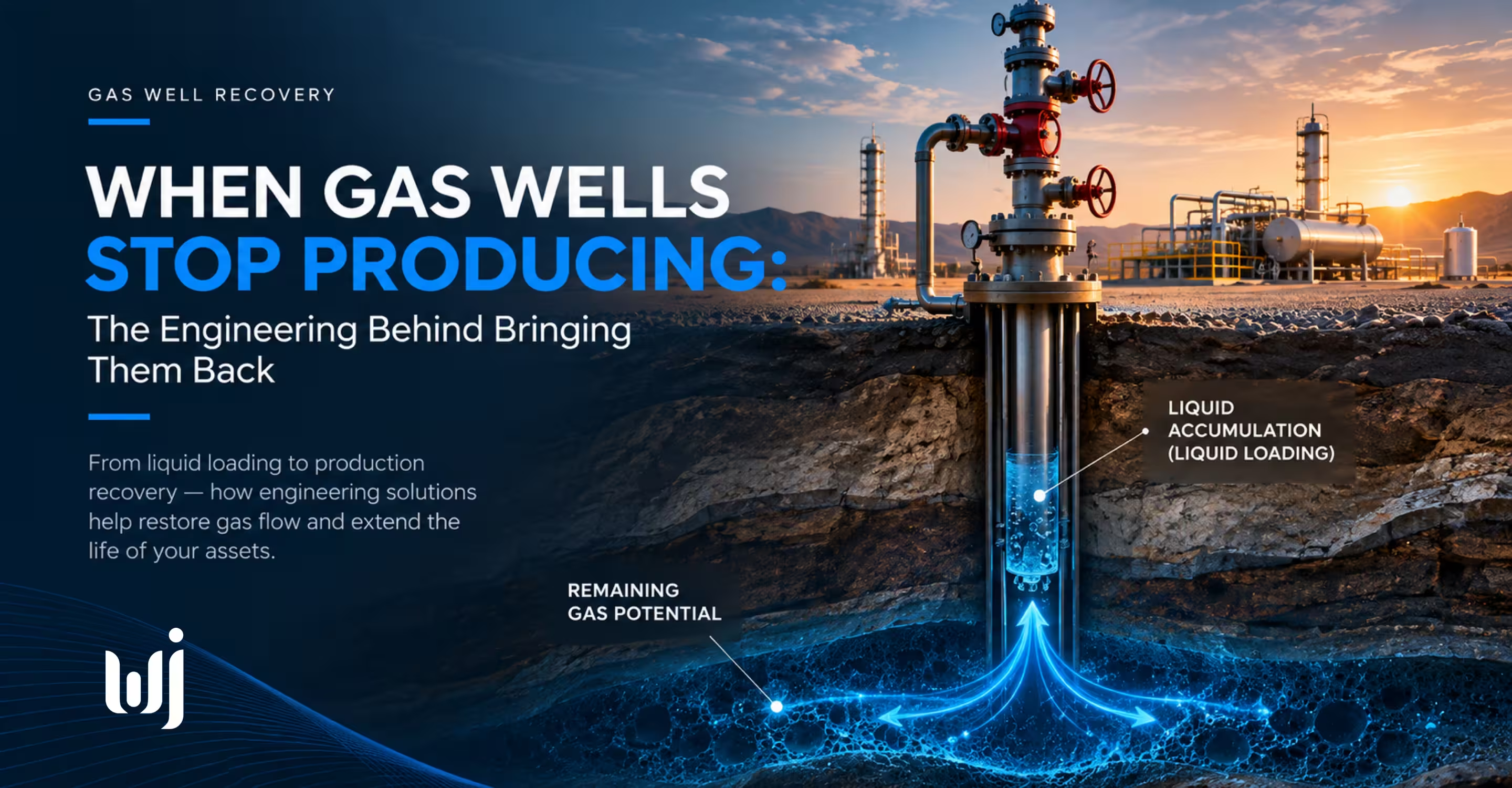
In natural gas production, declining output does not necessarily mean that a reservoir has reached the end of its productive life.
In some cases, recoverable natural gas remains underground, but changing pressure conditions, liquid accumulation, or mechanical restrictions prevent it from flowing efficiently to the surface.
As gas wells mature, reservoir pressure and production rates typically decline. These changes can reduce the ability of the gas stream to transport produced water and condensate through the production tubing.
When liquids begin accumulating within the wellbore, they create additional resistance to gas flow, potentially leading to unstable production, intermittent operation, or complete well shutdown.
The engineering challenge is not simply determining why a gas well has stopped producing, but identifying whether its remaining production potential can be recovered economically.
One of the common causes of declining production in mature gas wells is liquid loading.
During normal production, gas velocity may be sufficient to transport water and liquid hydrocarbons from the reservoir to surface facilities.
However, as production rates decline, gas velocity can fall below the level required for effective liquid transport.
Accumulated liquids increase hydrostatic pressure within the wellbore, reducing the pressure differential that drives natural gas from the reservoir toward the surface.
This can create a progressive cycle:
Importantly, liquid loading is only one possible cause of declining well productivity. Reservoir depletion, formation damage, mechanical restrictions, and excessive surface backpressure can produce similar operational symptoms.
Accurate diagnosis is therefore essential before selecting an intervention strategy.
Gas well deliquification, commonly referred to as dewatering when water is the primary accumulated liquid, involves removing or managing liquids that restrict natural gas production.
Several engineering solutions can be considered depending on well characteristics, reservoir conditions, production history, and economic feasibility.
Velocity Strings
Smaller-diameter production tubing can increase gas velocity under suitable operating conditions, helping the gas stream transport accumulated liquids to the surface.
Plunger Lift Systems
Plunger lift systems use available well pressure to periodically transport accumulated liquids through the tubing, helping certain wells maintain more stable production.
Foam-Assisted Dewatering
Specialized foaming agents, including suitable foam sticks or liquid treatments, can help reduce the effective density of accumulated liquids and improve their removal under appropriate operating conditions.
Artificial Lift Systems
Where natural reservoir energy is insufficient, selected pumping or artificial lift technologies can assist with removing accumulated liquids from the wellbore.
Compression and Surface Pressure Optimization
Appropriately designed compression systems can reduce surface backpressure, potentially increasing the pressure differential available for gas production and supporting more effective liquid transport.
Each technology has specific operating limitations, and no single solution is appropriate for every gas well.
The selection process must consider reservoir deliverability, well integrity, fluid characteristics, operating conditions, and the expected economic benefits of intervention.
Successful gas well recovery begins with understanding the complete production system.
A well that appears to suffer from liquid loading may also be affected by declining reservoir pressure, equipment deterioration, restrictions within the production tubing, or changes in surface operating conditions.
Engineering assessments may therefore involve reviewing production history, pressure measurements, fluid properties, well configuration, and equipment performance.
Analytical methods such as nodal analysis, inflow performance relationships (IPR), vertical lift performance (VLP) modeling, and critical gas velocity calculations can help identify production constraints and evaluate potential recovery strategies.
These assessments support decisions about whether intervention is technically feasible, which technology is appropriate, and whether the expected production improvement justifies the investment.
The objective is not merely to remove accumulated liquids temporarily, but to establish a sustainable operating strategy suited to the well's changing production characteristics.
Restoring production from existing wells can provide an alternative to relying exclusively on new drilling activities.
Where technically and economically feasible, effective liquid management may help operators recover gas production, improve well stability, and extend the useful life of existing production infrastructure.
However, successful recovery depends on several factors, including remaining reservoir potential, equipment condition, intervention costs, and long-term operational requirements.
At William Johnson Company, our capabilities across EPC, procurement, maintenance, and industrial equipment solutions support the engineering and infrastructure requirements of the energy sector.
Our focus on integrated technical solutions reflects the importance of reliable equipment, coordinated engineering, and practical implementation in addressing complex industrial challenges.
As operators seek to maximize the value of existing energy assets, production optimization and well intervention technologies remain important considerations for long-term asset management.
The development of new gas resources will remain essential to meeting global energy demand. However, improving the performance of existing production assets can also contribute to more efficient resource utilization.
A declining gas well is not necessarily an exhausted well.
In suitable circumstances, the underlying problem may be related to liquid accumulation or operating conditions rather than the absence of recoverable natural gas.
Through detailed engineering assessments, appropriate dewatering technologies, and effective production management, operators can identify opportunities to restore flow and improve the performance of existing wells.
Not every well can be recovered economically, and not every production decline can be reversed.
Sometimes, increasing natural gas production does not require discovering a new reservoir. It requires restoring the flow from a well that already exists.


