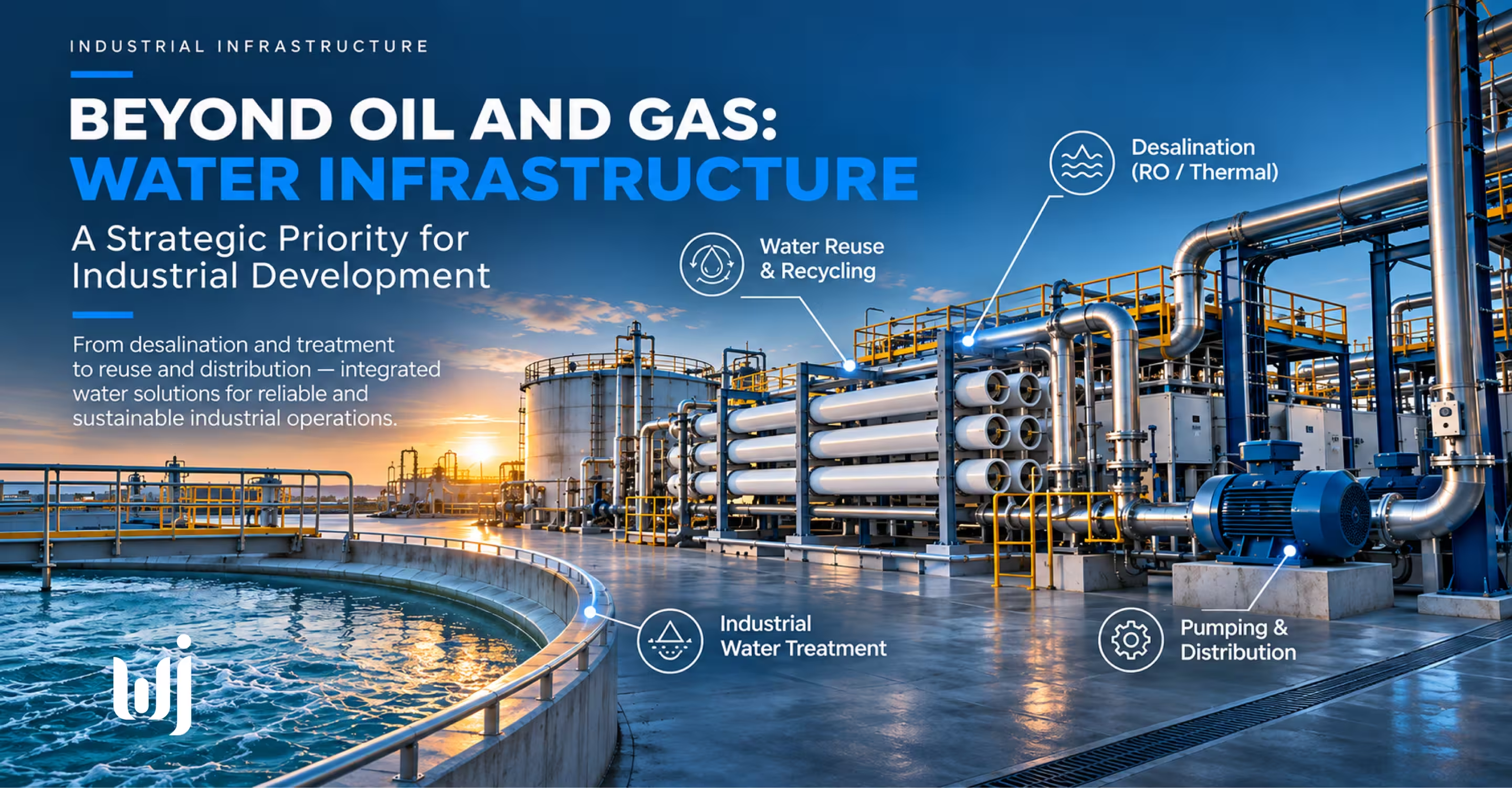
Industrial development has traditionally focused on oil and gas facilities, power generation plants, pipelines, and large-scale processing infrastructure. However, another essential resource plays an increasingly important role in maintaining reliable industrial operations: water.
Power plants depend on water for cooling and steam generation, while refineries, petrochemical facilities, and manufacturing installations require treated water for numerous production processes.
As industrial demand increases and freshwater availability becomes more constrained in many regions, reliable water supply, treatment, and distribution systems are becoming strategic infrastructure priorities.
Industrial water systems must meet specific requirements for quality, pressure, flow, and operational reliability. Interruptions or inadequate treatment can affect equipment performance, production efficiency, and facility availability.
Water infrastructure is not simply a supporting utility. It is an essential component of industrial performance.
In regions with limited freshwater resources, desalination provides an important alternative for securing dependable water supplies.
Modern desalination facilities use technologies such as Reverse Osmosis (RO) and thermal separation to convert seawater or brackish water into usable water.
Reverse osmosis systems rely on high-pressure pumps and specialized membranes to remove dissolved salts, while thermal desalination technologies use evaporation and condensation processes.
The selection of an appropriate technology depends on several factors:
For industrial applications, desalinated water may require additional treatment to meet the technical specifications of cooling systems, boilers, and other processes.
Successful desalination projects therefore depend on the integration of mechanical equipment, membrane technologies, electrical infrastructure, instrumentation, and automation systems.
Developing reliable water infrastructure is not limited to securing new water sources.
Industrial wastewater treatment and reuse can help reduce freshwater consumption and improve resource efficiency across industrial facilities.
Depending on the production process, wastewater may contain oils, suspended solids, dissolved chemicals, and other contaminants requiring specialized treatment.
Treatment technologies may include physical separation, chemical processing, biological treatment, membrane filtration, and advanced purification systems.
When appropriate treatment standards are achieved, reclaimed water can be reused for selected industrial applications, including cooling, utility operations, and certain manufacturing processes.
However, effective reuse requires careful evaluation of water quality, equipment compatibility, treatment reliability, and operational safety.
The objective is not simply to recover water, but to ensure that it meets the technical requirements of its intended application.
Industrial water infrastructure involves much more than installing pumps, pipelines, and filtration equipment.
Reliable operation requires coordinated engineering across multiple disciplines.
Hydraulic design must account for flow requirements, pressure losses, pumping efficiency, and distribution capacity. Mechanical equipment must withstand expected operating conditions and water characteristics.
Electrical and automation systems must support process monitoring, equipment protection, and operational continuity.
Treatment technologies must also be integrated with storage facilities, chemical dosing systems, instrumentation, and existing industrial infrastructure.
Without effective system integration, even high-quality equipment may fail to deliver the required treatment performance or operational reliability.
Engineering, Procurement, and Construction (EPC) plays a critical role in delivering complex water infrastructure projects.
Desalination plants, wastewater treatment facilities, pumping stations, and industrial water distribution networks require coordination between specialized process technologies and supporting infrastructure.
Effective EPC execution connects process engineering, equipment procurement, construction activities, and commissioning requirements within a coordinated project delivery strategy.
At William Johnson Company, our capabilities across EPC, procurement, maintenance, and industrial equipment solutions support the engineering requirements of complex industrial infrastructure.
Our approach emphasizes technical compatibility, reliable equipment selection, and coordinated project execution to support long-term operational performance.
As industrial facilities continue to evolve, water infrastructure represents an important area where integrated engineering solutions can contribute to operational reliability and resource efficiency.
The relationship between water and energy is becoming increasingly important in industrial planning.
Energy is required to extract, treat, desalinate, and distribute water, while water remains essential to many energy production and manufacturing processes.
This interdependence creates a need for infrastructure strategies that consider both resources together.
Investments in efficient treatment technologies, reliable distribution systems, and appropriate water reuse solutions can help industrial operators improve resource management and strengthen long-term operational resilience.
New energy facilities will remain essential to industrial development. However, dependable water infrastructure is equally important for ensuring that these facilities operate efficiently and consistently.
The future of industrial infrastructure will not be defined by energy production alone, but by how effectively every critical resource is managed to keep industry operating.


