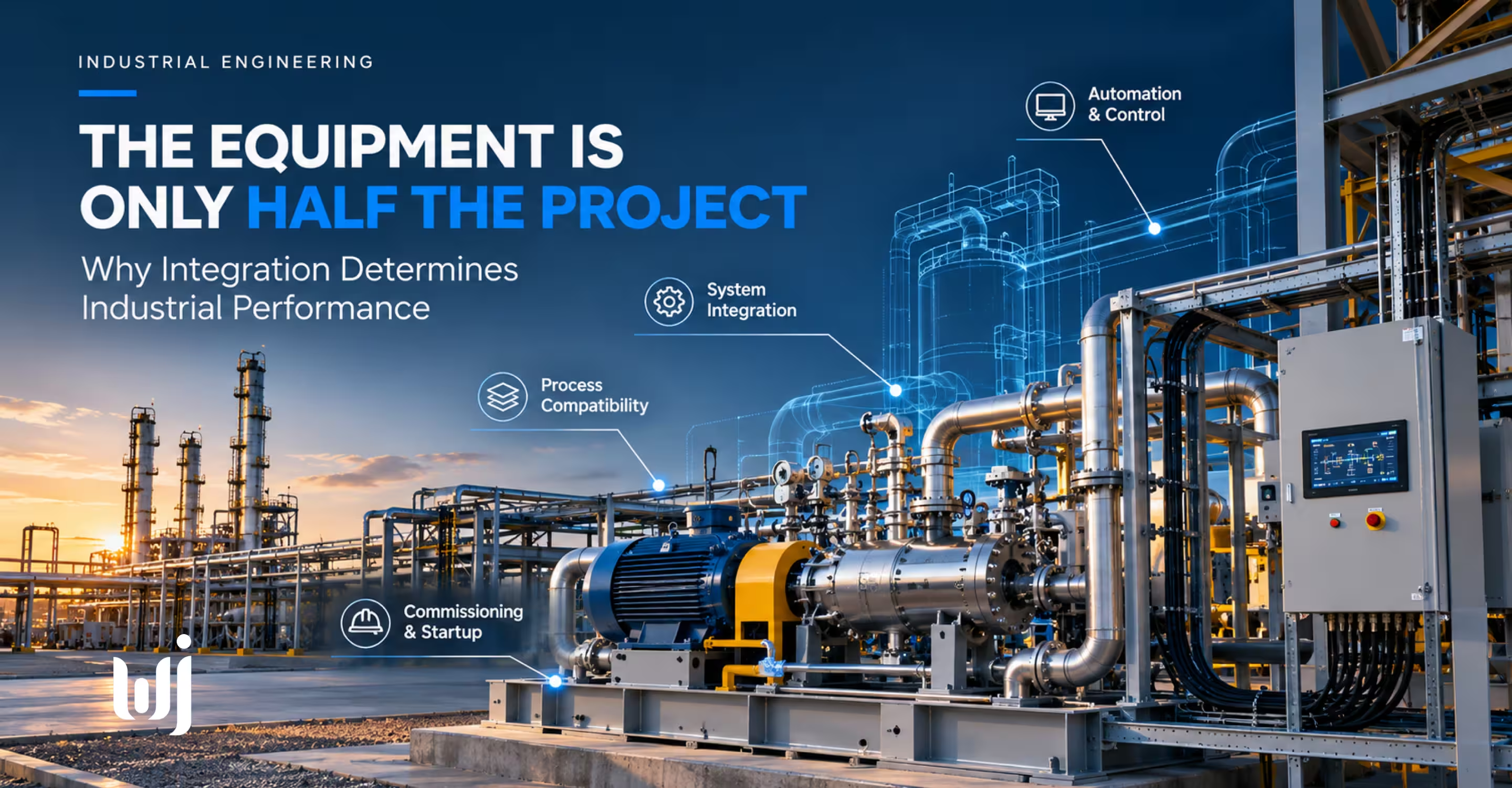
Why High-Quality Equipment Does Not Guarantee Performance
In industrial engineering, selecting reliable equipment is essential to developing efficient and dependable facilities. However, even advanced compressors, pumps, and control systems cannot guarantee successful performance when supporting infrastructure is not properly coordinated.
Oil and gas processing plants, refineries, and power generation facilities depend on interconnected mechanical, electrical, and automation systems.
For example, a compressor may meet all manufacturer specifications but fail to achieve its intended performance due to inadequate upstream separation, incompatible piping, insufficient cooling capacity, or poorly coordinated controls.
Similarly, a high-efficiency pump may experience operational difficulties when the hydraulic characteristics of its surrounding system are overlooked.
The real engineering challenge is not simply making individual equipment work. It is making the entire system work together.
Successful system integration starts during engineering and procurement, long before equipment arrives at the project site.
Technical teams must ensure that individual equipment packages meet the operating requirements of the complete facility.
Critical considerations include:
These requirements become especially important when equipment from multiple manufacturers must operate together.
Without proper interface management, technical inconsistencies can cause installation difficulties, engineering modifications, commissioning delays, and operational restrictions.
Modern industrial facilities rely on Programmable Logic Controllers (PLCs), Distributed Control Systems (DCS), SCADA platforms, and industrial instrumentation to coordinate equipment and maintain stable operations.
However, effective automation requires more than advanced hardware and software.
Control strategies must reflect actual equipment characteristics, process dynamics, and safety requirements.
For example, compressor operation may require coordination between pressure regulation, anti-surge protection, temperature monitoring, and emergency shutdown systems.
When these functions are not properly integrated, operational reliability may be compromised even if individual components perform correctly.
Effective automation ensures that equipment operates within defined technical and safety limits while responding appropriately to changing process conditions.
Completing equipment installation does not automatically mean that an industrial facility is ready for operation.
Commissioning verifies that installed equipment, control systems, and supporting infrastructure function together according to design requirements.
Typical activities include mechanical inspections, electrical testing, instrument calibration, control loop checks, functional testing, and controlled startup procedures.
Factory Acceptance Testing (FAT), Site Acceptance Testing (SAT), and Site Integration Testing (SIT) can also help verify equipment functionality and system compatibility at different project stages.
These procedures help identify integration problems before full-scale operation, reducing the risk of unexpected startup complications.
A facility is not operationally complete simply because every component has been installed. Its systems must function together as intended.
For Engineering, Procurement, and Construction (EPC) projects, integration must be considered throughout the entire project lifecycle.
Engineering establishes technical requirements, procurement ensures equipment compliance, construction manages installation, and commissioning verifies operational performance.
When these activities are managed independently, compatibility issues may emerge late in project execution, resulting in costly modifications and delays.
An integrated EPC approach aligns equipment selection, supplier coordination, engineering interfaces, installation activities, and operational requirements from the beginning.
This becomes particularly important for projects involving multiple equipment manufacturers, specialized technology packages, and complex industrial processes.
At William Johnson Company, our capabilities across EPC, procurement, maintenance, and industrial equipment packages reflect the importance of coordinated engineering and reliable project execution.
Industrial infrastructure requires more than individual equipment deliveries. Successful implementation depends on technical compatibility, effective procurement coordination, appropriate installation practices, and long-term maintenance considerations.
By approaching projects from a system-wide perspective, engineering teams can better address operational challenges and support dependable infrastructure performance.
The success of an industrial project cannot be measured solely by equipment quality or construction completion.
Reliable operation requires compatible equipment, validated automation, coordinated engineering interfaces, and systematic commissioning.
Even technically advanced machinery can create operational limitations when integration requirements are overlooked.
Conversely, effective system integration can improve equipment reliability, reduce technical risks, and support long-term operational efficiency.
In industrial engineering, performance is not defined by how well each component works independently, but by how effectively the entire system works together.


