Industrial construction has traditionally relied on extensive on-site activities, complex coordination between engineering disciplines, and carefully managed project schedules.
From oil and gas processing facilities to power generation plants and industrial infrastructure, large-scale projects require the integration of mechanical equipment, piping systems, electrical installations, instrumentation, and structural components.
However, industrial project delivery is evolving.
Rather than constructing and assembling every component at the final project location, developers are increasingly considering modular construction and prefabrication strategies.
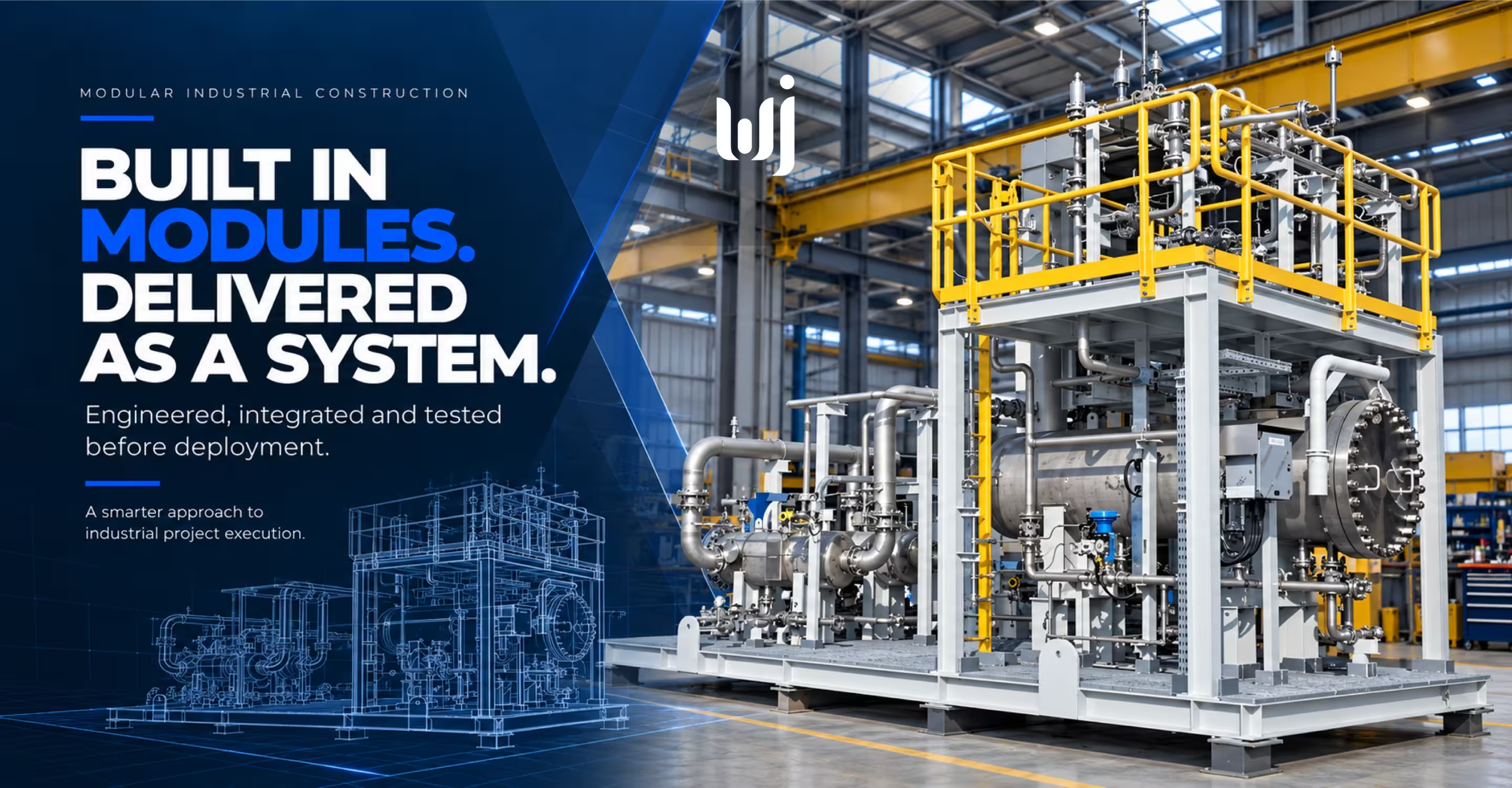
Under this approach, selected equipment packages and process systems are fabricated, assembled, and partially tested in controlled environments before transportation to the installation site.
The objective extends beyond reducing on-site construction activities. It involves improving how engineering, procurement, fabrication, logistics, and commissioning are coordinated throughout the project lifecycle.
Modular construction is not simply about changing where equipment is assembled. It is about changing how complete industrial systems are delivered.
Modular construction transfers selected fabrication and assembly activities from the project site to specialized manufacturing facilities or fabrication yards.
Depending on the technical requirements, industrial modules may incorporate process equipment, piping networks, valves, instrumentation, electrical components, and structural frameworks.
One important advantage is the ability to perform certain activities simultaneously.
While civil works and foundations are being prepared at the project location, equipment fabrication and module assembly can progress off-site.
This parallel execution may help reduce overall project schedules, particularly where site access, workforce availability, environmental conditions, or operational restrictions create construction challenges.
Controlled fabrication environments can also support more consistent quality inspections, equipment alignment, and pre-commissioning activities.
However, these benefits depend on early engineering decisions and effective coordination between all project participants.
A defining characteristic of modular execution is the integration of multiple components into a coordinated system before delivery.
In conventional construction, individual equipment packages may arrive separately, requiring extensive field assembly, piping connections, electrical installation, and system verification.
Modular solutions allow selected integration activities to take place earlier.
For example, skid-mounted equipment packages can combine pumps, compressors, filtration systems, valves, piping, instrumentation, and control components within a defined structural arrangement.
Such packages can be designed around specific operating requirements and prepared for connection to the wider industrial facility.
Potential applications include:
These solutions can reduce certain installation requirements while supporting systematic equipment inspection and testing.
Nevertheless, successful integration requires careful management of mechanical, electrical, instrumentation, and process interfaces.
A module is not simply equipment mounted on a structure. It is an engineered system that must operate reliably within a larger industrial process.
Although modularization can simplify certain construction activities, it introduces additional engineering and logistical considerations.
Module dimensions, transportation routes, weight restrictions, lifting requirements, structural loads, and installation sequences must be evaluated during the early design stages.
A technically efficient equipment arrangement may become impractical if its dimensions exceed transportation limitations or if suitable lifting equipment is unavailable at the destination.
Similarly, late engineering modifications can affect fabrication progress, procurement schedules, and system interfaces.
This makes early coordination particularly important.
Engineering teams must work closely with procurement specialists, fabrication contractors, logistics providers, and site construction teams to ensure that the selected modular strategy remains technically and commercially feasible.
Successful modular execution requires optimization of the complete delivery process, not simply the relocation of construction activities.
For Engineering, Procurement, and Construction (EPC) projects, modularization represents an alternative approach to managing technical complexity and project execution.
When properly implemented, modular solutions may offer several advantages:
However, modular construction is not appropriate for every project.
Large transportation distances, restricted site access, equipment dimensions, and project-specific technical requirements can limit its feasibility.
In some cases, conventional construction or a hybrid strategy combining modular packages with on-site assembly may provide a more effective solution.
The selection should therefore be based on detailed engineering assessments, execution planning, logistics studies, and lifecycle cost considerations.
At William Johnson Company, our capabilities across EPC, procurement, maintenance, and industrial equipment packages reflect the importance of integrated engineering and coordinated project execution.
Industrial projects increasingly require solutions that connect equipment selection, technical compatibility, supply chain management, and installation requirements.
Whether a project follows a conventional construction strategy, incorporates modular equipment packages, or combines both approaches, successful execution depends on the effective integration of engineering disciplines and project activities.
Our focus remains on supporting industrial clients with practical solutions aligned with their technical requirements, operational objectives, and long-term infrastructure needs.
The development of modular construction reflects a broader transformation in industrial project delivery.
Engineering decisions increasingly influence manufacturing strategies, transportation planning, installation efficiency, and operational performance.
Rather than evaluating individual equipment packages and construction activities separately, project teams must consider how these elements function together as part of a complete industrial system.
Modularization offers one approach to achieving this integration, particularly when supported by early planning, accurate engineering, and disciplined execution.
The future of industrial construction may not be defined by larger construction sites, but by smarter ways of engineering, integrating, and delivering complete industrial systems.


