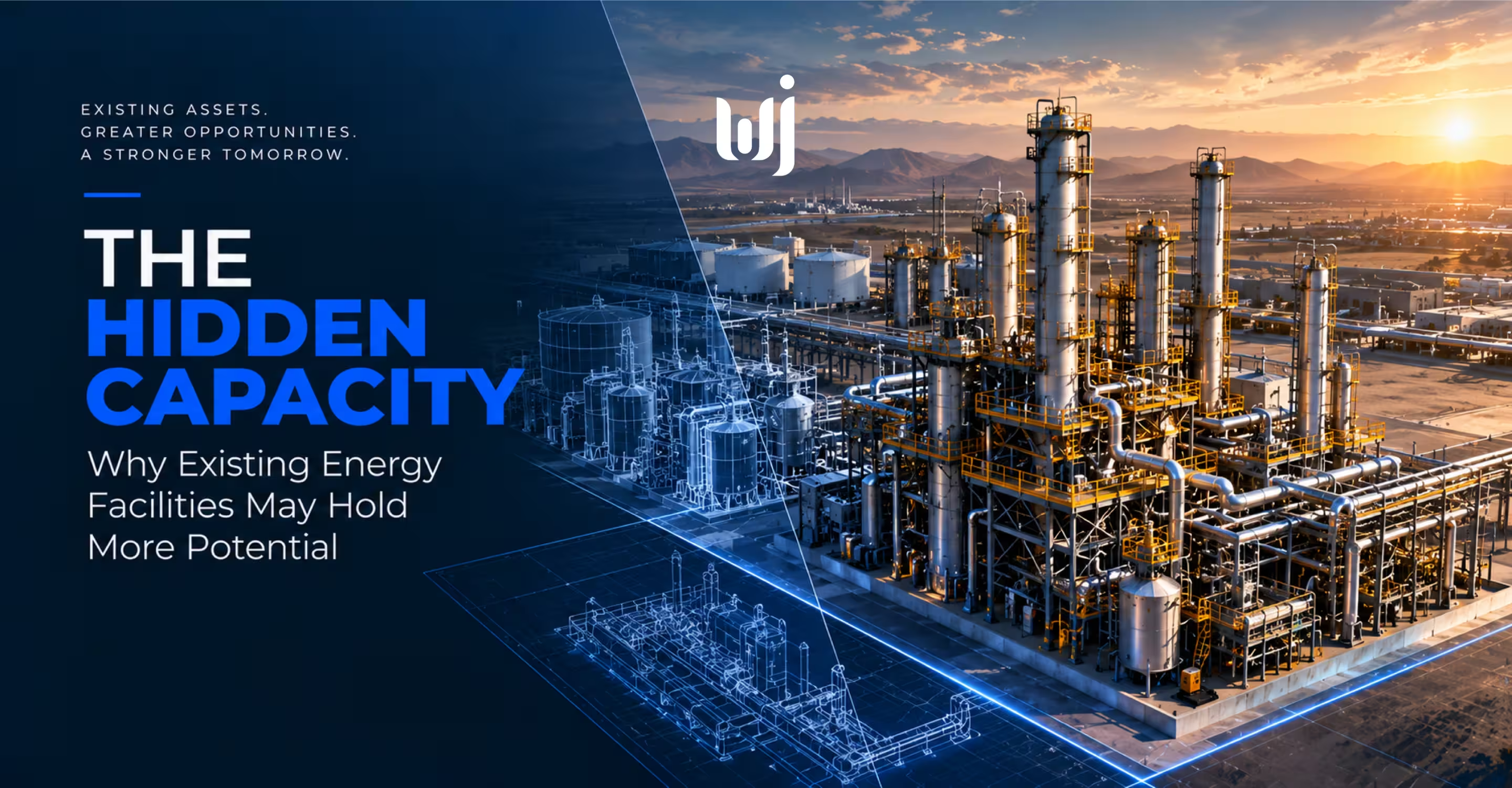
In the energy industry, growth is often measured by the construction of new processing plants, refineries, pipelines, and production facilities. However, increasing industrial capacity does not always require building new infrastructure.
Many operating facilities contain opportunities for performance improvement that remain unrealized due to equipment limitations, process inefficiencies, outdated configurations, or changes in operating conditions.
A facility originally designed for specific production requirements may no longer operate at its optimal capacity as feedstock characteristics, demand, and technical requirements evolve.
Identifying these limitations can reveal opportunities to increase throughput, improve equipment reliability, and extend asset life without committing to an entirely new construction project.
The question is not always how much new infrastructure is needed, but how much additional performance existing infrastructure can deliver.
One of the most effective approaches to improving existing industrial assets is plant debottlenecking.
Debottlenecking involves identifying and addressing the technical constraints that prevent a facility from reaching its potential production capacity.
These constraints can occur across multiple systems, including compressors, pumps, heat exchangers, separation equipment, pipelines, and process control systems.
Depending on the facility's operating conditions, potential improvements may include:
Effective debottlenecking begins with a comprehensive technical assessment. Engineers must determine where constraints occur, how different systems interact, and whether proposed modifications can deliver measurable operational improvements.
Importantly, increasing capacity in one part of a facility must not create new limitations elsewhere.
Industrial expansion generally follows two approaches: greenfield development and brownfield modernization.
Greenfield projects involve constructing new facilities, often requiring extensive infrastructure development, site preparation, equipment installation, and commissioning.
Brownfield projects, by contrast, focus on modifying, upgrading, or expanding existing industrial assets.
Where technically and commercially feasible, brownfield development can provide several advantages, including lower capital requirements, shorter implementation schedules, and the ability to utilize established infrastructure.
However, modernization within an operating facility introduces additional complexities.
Existing equipment must be evaluated for compatibility, construction activities must be coordinated with operational requirements, and safety procedures must account for work taking place near active industrial systems.
These conditions require detailed engineering, disciplined project planning, and close coordination between procurement, construction, operations, and commissioning teams.
The success of a brownfield project depends not simply on installing new equipment, but on integrating modifications into an existing operational environment.
The decision to modernize an existing facility should be supported by both technical and economic evaluation.
Although new construction may offer greater design flexibility, upgrading existing infrastructure can sometimes provide a more capital-efficient route to increasing production.
Potential benefits include improved equipment utilization, reduced energy consumption, lower maintenance requirements, and increased operational availability.
However, the economic case must also account for implementation costs, operational interruptions, equipment compatibility, and the expected remaining life of the facility.
A technically achievable upgrade is not necessarily a commercially attractive investment.
For this reason, engineering assessments should evaluate the relationship between capital expenditure, expected performance improvements, operational risks, and long-term asset value.
At William Johnson Company, our capabilities across engineering, procurement, construction, maintenance, and industrial equipment packages support the development and modernization of energy infrastructure.
From technical assessments and equipment selection to procurement and project execution, an integrated engineering approach helps operators address complex industrial requirements.
For existing facilities, this means evaluating potential improvements within the broader operating system rather than treating individual equipment upgrades as isolated solutions.
By aligning engineering decisions with operational objectives, industrial companies can pursue improvements in reliability, efficiency, and long-term asset performance.
As energy companies face growing pressure to improve capital efficiency, maintain production reliability, and adapt to changing market conditions, existing infrastructure deserves greater strategic attention.
Greenfield construction will remain essential for developing new resources and expanding industrial capacity. Nevertheless, brownfield modernization and debottlenecking can offer valuable alternatives when existing assets have technically recoverable capacity.
The most effective investment strategy is not necessarily the one that builds the largest new facility. It is the one that delivers the greatest sustainable operational value.
Sometimes, the next major increase in production does not require a new plant. It requires understanding what the existing plant is already capable of achieving.


