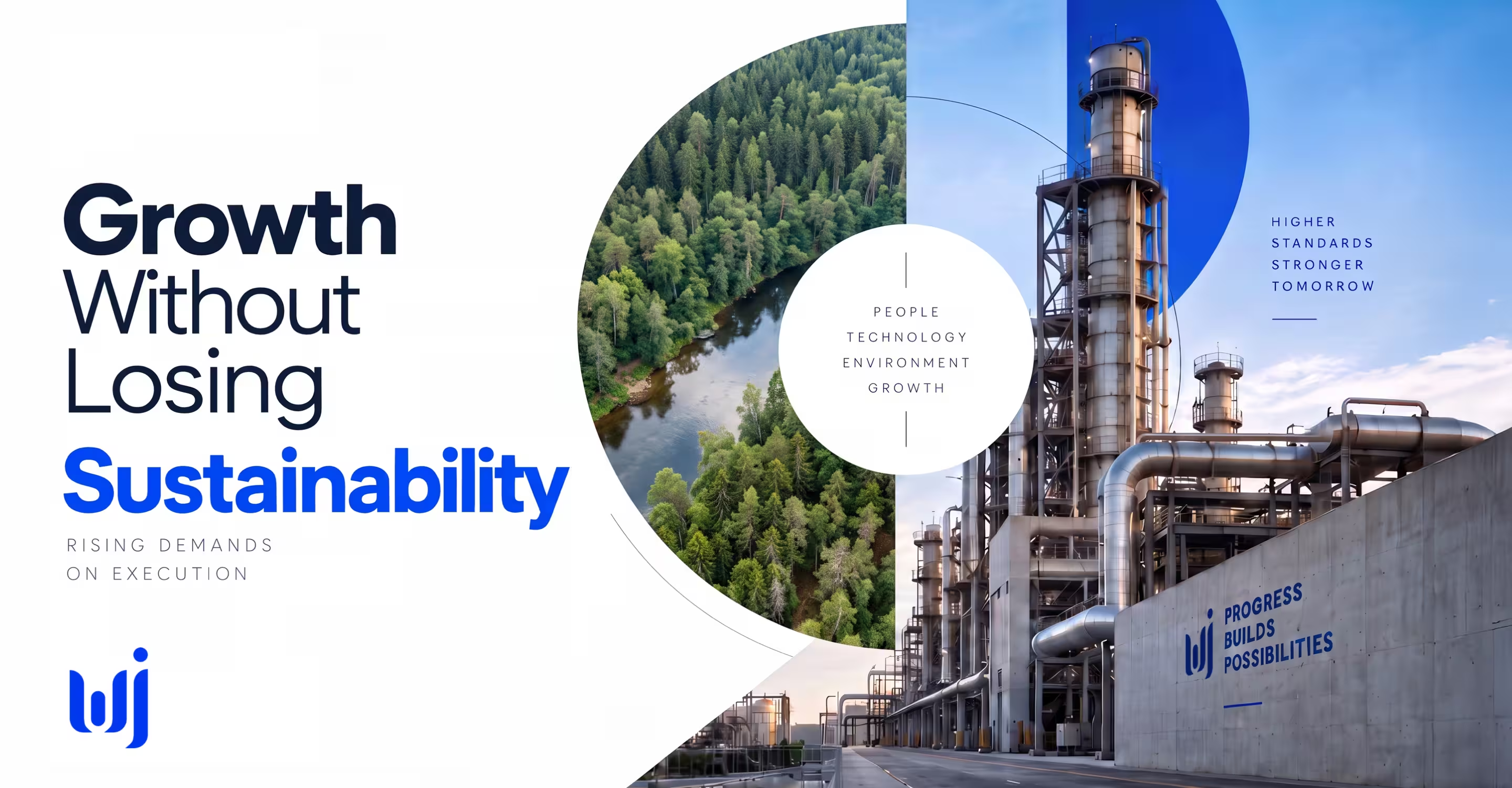
The modern industrial market simultaneously demands three things that were once perceived as conflicting: growth, speed, and sustainability.
Companies can no longer choose one of the three. They must build an operating model capable of working in all three directions at once.
This shift is changing how industrial companies approach project execution, operational management, engineering decisions, and long-term growth.
Ten years ago, a company could increase its project volume and maintain quality through extensive approaches, primarily by adding more people, resources, and capacity.
Today, this is no longer enough.
The market expects companies to grow while maintaining execution quality and reducing environmental impact at the same time. This triple expectation has become part of the new industrial standard.
As project portfolios expand, organizations must therefore develop operating models that can scale without weakening technical quality or sustainability.
Traditional project execution has often been assessed primarily through two parameters: whether the project was delivered on time and whether it remained within budget.
Those metrics remain critical, but the definition of execution quality is becoming broader.
Execution discipline now has to include communication quality, sustainability of technical solutions, project energy efficiency, and compliance with regulatory requirements.
Together, these factors increasingly determine whether a project can be considered successfully executed.
The balance between growth and sustainability does not appear automatically as a company expands.
It must be built into the organization's operating culture through internal standards, team training, engineering processes, and disciplined decision-making.
Clear procedures help teams maintain consistent execution across multiple projects. Technical standards provide a common framework for engineering decisions, while continuous training allows specialists to respond effectively to evolving technologies and regulatory requirements.
This operating culture is what separates companies capable of sustaining long-term growth from those that accelerate temporarily and eventually begin losing quality.
Technology plays an important role in maintaining this balance.
Digital project-monitoring tools, transparent reporting systems, integrated data platforms, and automation of routine processes can help organizations manage increasing project volumes without losing visibility or operational discipline.
Digitalization can improve coordination, identify risks earlier, standardize workflows, and provide management teams with more accurate information for decision-making.
However, technology alone cannot create execution discipline.
Digital tools deliver value when they operate within a strong management framework.
Without clear responsibilities, engineering standards, effective communication, and disciplined decision-making, introducing additional technology may simply digitize inefficient processes.
Technology should therefore reinforce an established operating culture rather than attempt to replace it.
When strong management practices and appropriate digital tools work together, companies become better positioned to scale operations while preserving execution quality and sustainability.
Growth without losing sustainability should not be viewed as a compromise between commercial performance and environmental responsibility.
It represents a higher standard of execution.
Companies that can increase project capacity, respond quickly to market requirements, maintain technical quality, and integrate sustainability into their operations will be better positioned to build lasting relationships with clients and partners.
For industrial organizations, execution capability is therefore becoming an increasingly important competitive differentiator.
Growth, speed, sustainability, and execution quality are becoming interconnected parts of the same operating model.
The companies that succeed over the long term will be those capable of scaling without weakening their engineering standards, management discipline, or commitment to sustainable solutions.
Growth without losing sustainability is not a compromise. It is a higher standard of execution that the market has already reached.
%20(1).jpg)


.svg)
.svg)

