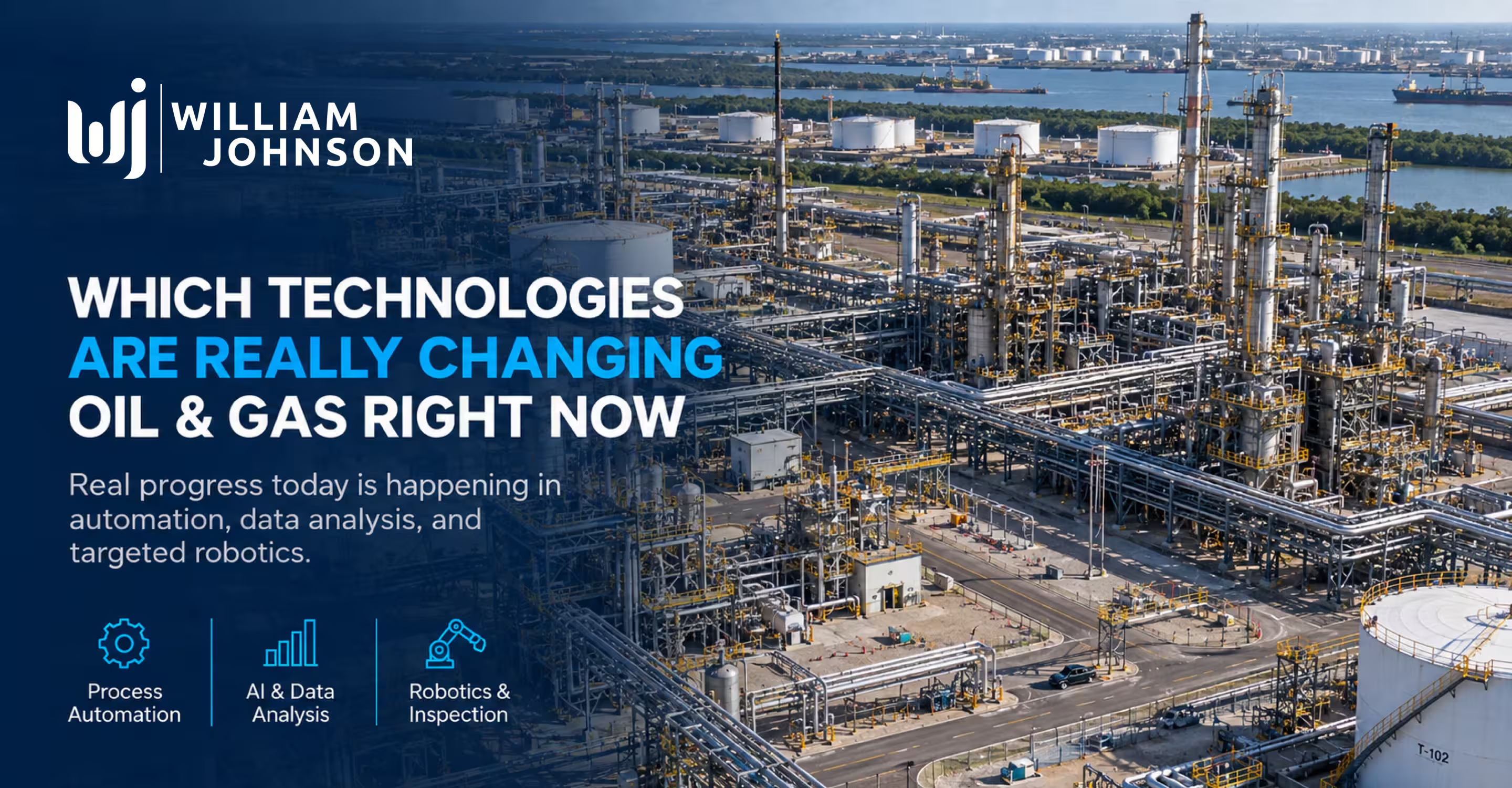
There is plenty of hype around digitalization, artificial intelligence, and robotics in the oil and gas industry. New technologies are regularly presented as solutions capable of transforming operations, reducing costs, improving safety, and increasing efficiency.
But when presentations and technological hype are set aside, the picture becomes more concrete.
Some technologies are already changing everyday operating practice and delivering measurable results. Others remain highly dependent on data quality, operating conditions, infrastructure, and the specific requirements of each project.
Understanding this distinction is becoming increasingly important for engineering companies and industrial operators.
Process automation is one of the most mature technology developments in the industry.
Automation systems already provide practical value across predictive maintenance, equipment monitoring, operational control, and project management.
The objective is not simply to replace human involvement. In many applications, the greater value comes from reducing routine errors, improving data quality, standardizing processes, and providing technical teams with better information for decision-making.
As industrial facilities become increasingly connected, automation is becoming part of the fundamental infrastructure required for efficient and reliable operations.
Artificial intelligence has significant potential in oil and gas, but its effectiveness depends heavily on the availability and quality of historical data.
AI can already provide practical benefits in areas such as:
Where sufficient historical data exists, AI can help companies produce more accurate estimates, detect anomalies earlier, and improve operational decisions.
Where data is limited, fragmented, or processes are highly individual, AI remains primarily a supporting tool rather than an independent decision-making system.
Robotics is developing more slowly on real industrial sites than technological presentations sometimes suggest.
Oil and gas facilities present particularly difficult conditions for robotic systems. Physical environments can be complex, hazardous, geographically distributed, and highly specific to individual facilities.
Despite these challenges, robotics is already finding practical applications in selected areas, particularly inspection, diagnostics, and maintenance in hazardous or difficult-to-access environments.
In these applications, robotic systems can reduce human exposure to risk while improving the consistency and frequency of inspection activities.
Technology creates value when it addresses a clearly defined operational or engineering requirement.
Implementing AI, automation, or robotics simply because the technology is considered innovative does not necessarily improve project performance.
Before introducing a new solution, industrial companies need to understand the technical problem being addressed, the quality of available data, integration requirements, operating conditions, implementation costs, and expected impact on performance.
This turns digitalization from a technology initiative into an engineering decision.
A modern industrial partner must be able to separate technological noise from practical value.
Not everything that looks innovative improves project execution. A technology may be highly advanced while still being inappropriate for a particular facility, process, or operating environment.
The real value of engineering expertise lies in determining where a technology can deliver measurable benefits, how it should be integrated, and whether the expected improvement justifies the complexity and investment required.
Automation, AI, and robotics are already influencing the oil and gas industry, but they are developing at different speeds and delivering different levels of practical value.
Process automation has reached a high level of maturity. AI provides strong opportunities where reliable historical data exists. Robotics is establishing its role in specialized applications such as inspection, diagnostics, and hazardous-area maintenance.
The objective should not be to adopt the newest technology available. It should be to select the technology that solves the right problem.
Not everything that looks innovative actually improves the project. What matters is knowing which technology applies to a specific project and which one still remains marketing.
%20(1).jpg)


.svg)
.svg)

