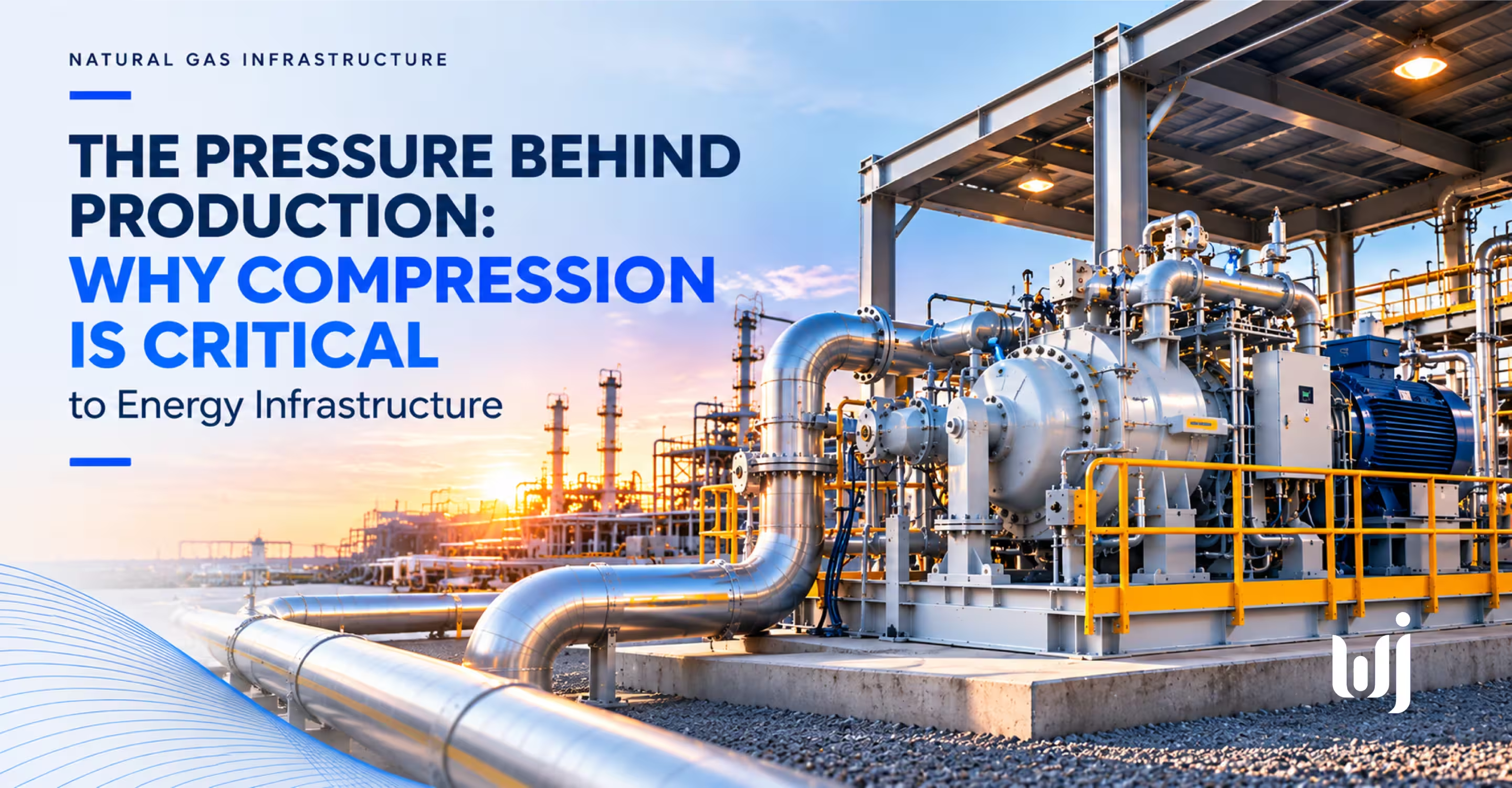
Natural gas production and transportation depend on maintaining sufficient pressure throughout interconnected industrial networks.
As gas travels through pipelines, friction and hydraulic effects gradually reduce its pressure, potentially limiting transportation capacity over extended distances.
Gas compressor stations address this challenge by increasing pressure at strategic locations throughout the transmission network, supporting continuous gas flow between production facilities, processing plants, storage systems, and downstream consumers.
However, effective compression requires more than increasing pressure. Gas composition, flow rates, pipeline configuration, and downstream operating conditions must all be considered during system design.
Natural gas facilities rely on different compression technologies depending on process requirements and operating conditions.
Selecting the appropriate technology requires evaluating gas properties, operating pressure, energy consumption, maintenance requirements, and lifecycle costs.
A compressor must be selected according to the requirements of the complete industrial system rather than its individual performance specifications alone.
A compressor station is a complex industrial facility incorporating multiple interconnected mechanical, electrical, and control systems.
Reliable operation depends on the effective integration of gas separation, filtration, cooling, lubrication, sealing systems, instrumentation, and automation.
For centrifugal compressors, anti-surge control systems play an essential role in preventing unstable operating conditions. Vibration monitoring, temperature protection, pressure regulation, and emergency shutdown systems further support equipment reliability and operational safety.
Each supporting system must be designed around the compressor's operating characteristics and the requirements of the wider gas network.
The reliability of a compressor station depends not only on the quality of its machinery, but also on the engineering behind its integration.
Natural gas infrastructure rarely operates under constant conditions. Declining reservoir pressure, changing gas composition, fluctuating production volumes, and downstream demand can influence compressor performance.
Equipment originally selected for a specific operating envelope may become less efficient as these conditions evolve.
Engineering assessments involving compressor performance maps, pressure ratios, gas properties, and operating scenarios can help identify potential improvements.
Depending on the findings, operators may consider control system optimization, equipment modifications, supporting infrastructure upgrades, or additional compression capacity.
These interventions can help maintain operational flexibility and improve the utilization of existing compression infrastructure.
Developing gas compressor stations requires coordinated Engineering, Procurement, and Construction (EPC) activities across multiple technical disciplines.
Beyond compression equipment, these projects involve process piping, electrical infrastructure, instrumentation, structural systems, utilities, safety arrangements, and commissioning.
At William Johnson Company, our EPC portfolio includes a gas turbine compressor station developed as part of a gas chemical complex project, reflecting the importance of integrated compression infrastructure within industrial energy systems.
Our broader capabilities across EPC, procurement, maintenance, and industrial equipment solutions support a comprehensive approach to infrastructure development and operational reliability.
As natural gas continues to support power generation, industrial production, and international energy transportation, compression remains a fundamental element of reliable infrastructure.
Properly engineered compressor systems support transportation capacity, process stability, operational flexibility, and long-term equipment performance.
Achieving these outcomes requires coordinated engineering, appropriate equipment selection, effective system integration, and disciplined maintenance strategies.
Behind every reliable natural gas network lies an essential engineering principle: maintaining the pressure that keeps production moving.


